
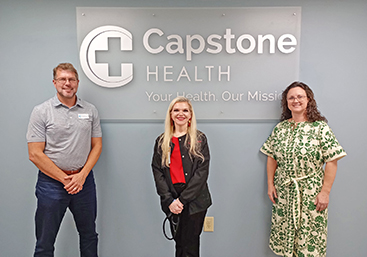
From left, David Jones, executive director for Capstone Health, Capstone Nurse Practitioners Angela McNutt and Holly Whitman.
WINSTON COUNTY - Medical officials are wanting the public to be better educated about hepatitis C - a viral infection known to cause liver damage - and that screenings and treatment are available locally.
Capstone Health has proposed the Capstone Health Access and Mentorship Partnership, a rural hepatitis C virus screening, treatment and care coordination initiative, designed to improve access to HCV services in Winston and Walker counties, thanks to $260,000 in rural health funding received by Capstone as part of the $144 million in federal funding the state has received, announced August 24, by Governor Kay Ivey as part of the Alabama Rural Health Transformation Program (ARHTP).
Among the 138 grants awarded statewide to support projects covering healthcare in rural areas, Capstone received just over $260,000 related to hepatitis C diagnosis, treatment and prevention out of its Double Springs clinic and a separate $250,000 for its Walker County clinic to expand its hours, medical officials confirmed.
“Alabama is serious about creating systematic changes through the ARHTP to ensure every citizen has access to quality care,” Ivey stated. “This program is enabling institutions covering every part of the state to improve healthcare for Alabamians through projects that are both innovative and sustainable,” the governor added.
The $250,000 grant will go to Capstone’s facility in Walker County to provide expanded hours so that those who may not be able to come to Winston County’s location on weekends can visit the Walker County location, Capstone Executive Director David Jones explained.
Capstone’s Winston County clinic is open Monday through Friday from 8 a.m. until 5 p.m., Jones said.
“If you’re a patient at one clinic, you’re a patient at all the clinics,” Jones emphasized.
Jones further explained the $260,060 for Capstone’s Winston County clinic will be directed toward enhancing prevention, detection and treatment for hepatitis C.
“Hepatitis C can be caused by numerous things, but most of the time it’s blood sharing,” Jones pointed out. “If we had someone who used drugs in the past, they could have had hepatitis C for a long time.
“If someone got a blood transfusion prior to 1992 (around the time they began screening donated blood for hepatitis C,) they have a chance of having hepatitis C,” Jones explained. “It’s a virus that particularly affects the liver. A certain percentage of people with hepatitis C will develop cirrhosis from that.
“We don’t normally have vaccinations for hepatitis C,” Jones continued. “Before, treatment was really hard to get.”
There are two primary types of Hepatitis C. Acute is a short-term stage within the first six months of exposure, while chronic is a long-lasting infection that, without treatment, can cause severe liver damage, Jones confirmed.
Hepatitis C spreads when blood carrying the virus enters an uninfected person’s bloodstream, usually caused by sharing needles or drug-injection methods, unsterilized piercings or tattoos or shared personal items such as razors and toothbrushes, Jones further confirmed.
See complete story in the Northwest Alabamian.
Subscribe now!